
Participants
The Participants page is the cross-matter directory of every individual your organization has interacted with. Where the Clients page focuses on the people you have a service relationship with, Participants is broader — it includes counterparties on the other side of a transaction, third-parties mentioned on a matter, and the staff members assigned to those matters.
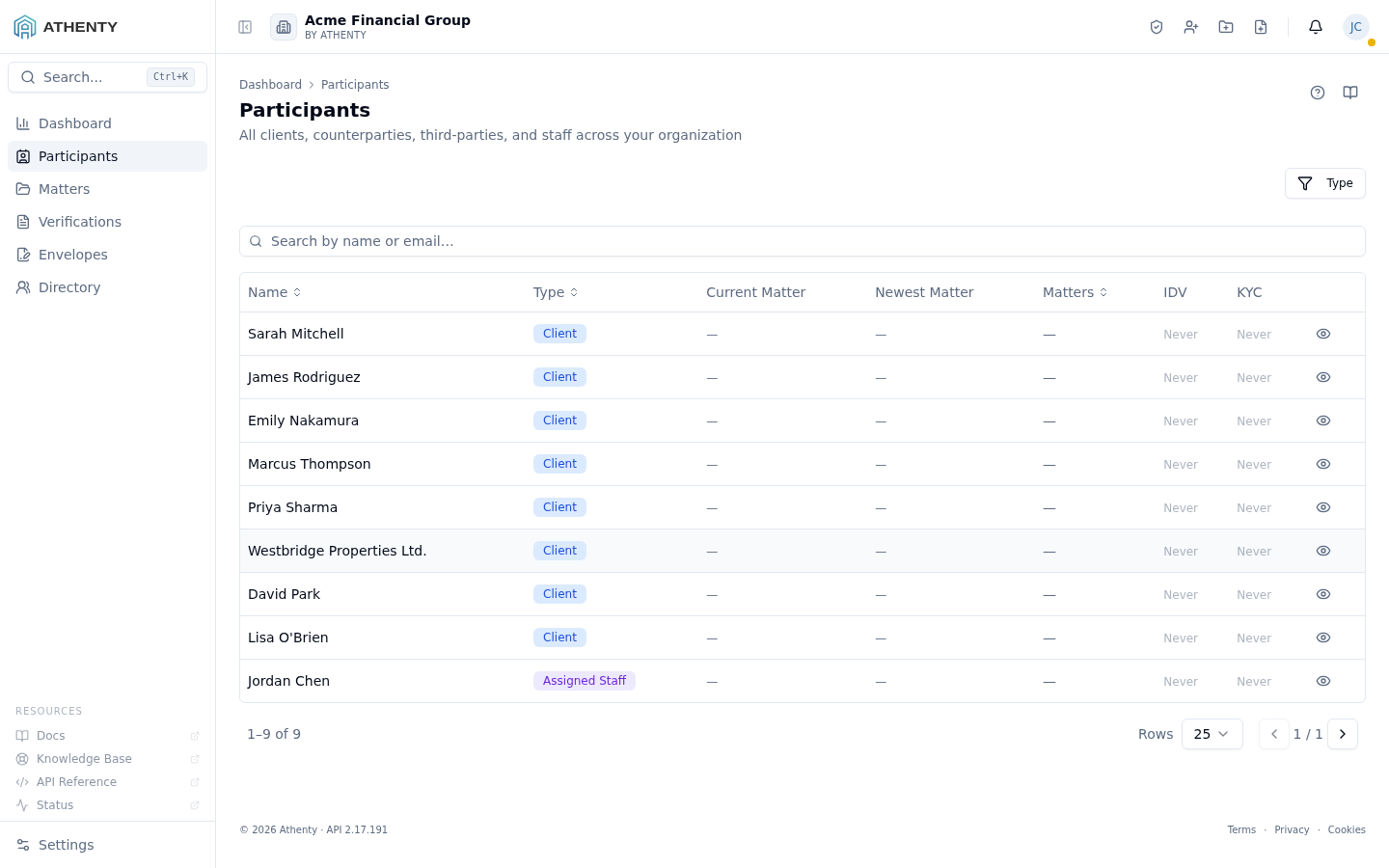
Anatomy of the page
Section titled “Anatomy of the page”1. Header and utility icons
Section titled “1. Header and utility icons”The page header shows the title Participants, a one-line description, and the standard Help (?) and Docs (book) icons in the top-right. Help opens an in-portal slide-out summary; Docs opens this page in a new tab.
2. Involvement filter
Section titled “2. Involvement filter”A single-select dropdown lets you narrow the table to one involvement at a time:
- Clients — people on your side of the transaction
- Counterparties — people on the other side
- Third-parties — non-transacting individuals named on a matter
- Assigned Staff — your own users assigned to matters
Clearing the filter shows everyone.
3. Search
Section titled “3. Search”The search box matches on name and email. Results update as you type and respect the active involvement filter.
4. Participants table
Section titled “4. Participants table”| Column | Description |
|---|---|
| Name | Display name with a red triangle if a potential conflict has been detected |
| Involvement | One or more involvement badges (a single person can be both a client and a counterparty across different matters) |
| Current Matter | Most recently active matter — clickable |
| Newest Matter | Most recently added matter — clickable |
| Matters | Total matter count across all time |
| IDV | Last identity verification date, color-coded by status |
| KYC | Last KYC check date, color-coded by status |
The status colours follow a consistent convention across the portal:
- Green — approved / passed
- Amber — pending / in progress
- Red — rejected
- Orange — expired
- Grey “Never” — no verification on file
How a participant is drawn
Section titled “How a participant is drawn”Every place Athenty shows a person or an entity — this table, a matter’s participant list, any dropdown you pick from, the duplicate-detection warning — uses the same compact representation, so you can read it anywhere without relearning it.
Individual vs entity
Section titled “Individual vs entity”The avatar’s shape carries the type, so it survives greyscale and colour-blindness:
- Circle (light blue) — an individual (a person).
- Square (navy) — an entity: a company, trust, estate, or other non-person participant.
Where there is room for a second line, the type is also written out as an INDIVIDUAL / ENTITY badge.
The Participant ID
Section titled “The Participant ID”The short number beside the name is that participant’s Participant ID — the same identifier that leads their profile, the way a Matter ID leads a matter. It appears at every size and on every surface, including picker rows and the duplicate-detection panel.
Use it to tell two people with the same name apart, and to quote a specific participant to a colleague. Athenty never shows you an internal database identifier in its place.
The gold star (★) — “primary”
Section titled “The gold star (★) — “primary””A gold star immediately left of a name means that one is the primary. It has exactly one meaning wherever it appears:
| Where you see it | What it means |
|---|---|
| Beside a person listed on an entity | That person is a Primary Contact of the entity — the individual you deal with for that company or trust |
| Beside a client on a matter | That client is the matter’s Primary Client |
| Beside a matter on a participant’s profile | That participant is the Primary Client on that matter |
| In the primary-contact picker | That person is already a primary contact of the entity |
The star always carries a spoken label for screen readers (“Primary client”, “Primary contact”), so the meaning never depends on seeing the colour.
An entity can have more than one Primary Contact — designating a new one never removes an existing one — so you may see several starred people on one entity.
Making someone a Primary Contact shows you what they will see. A Primary Contact can see the entity’s matters in the client portal. So whenever you make someone a Primary Contact — from the entity’s Relationships tab, or by picking them as the contact while adding the entity to a matter, an envelope or a verification — Athenty first lists the entity’s matters they will be able to see, each with a switch. Every matter starts switched on (or as you last set it, if they are already a Primary Contact of that entity); turn off any they should not see, then choose Confirm. The same list appears when you restore a Primary Contact whose role had ended. The switches apply to that one person, whichever of their roles at the entity makes them a Primary Contact. Cancel saves nothing. If the entity has no matters in the client portal yet, there is nothing to confirm and no list appears.
Participant pictures
Section titled “Participant pictures”The circle or square beside a participant’s name shows a picture when one is available and the participant’s initials when not. You see the same picture in the directory, on the profile, in pickers and on the Relationships tab.
Which picture is shown
Section titled “Which picture is shown”Athenty uses the first of these that exists and that you are allowed to see:
| Order | Picture | Notes |
|---|---|---|
| 1 | A photo or logo your organization chose | Picked by a colleague on the participant’s profile. It wins over everything below, for everyone in your organization, until someone changes or removes it. |
| 2 | The photo from their identity verification | The selfie is preferred; if there is no usable selfie, the photo on their ID document is used. For an entity, the logo it added during its verification. |
| 3 | Their public Gravatar picture | Only if an Owner has turned on Use Gravatar for participant pictures. Off by default. |
| 4 | Initials | Always available. |
Why two colleagues can see different pictures
Section titled “Why two colleagues can see different pictures”A verification photo belongs to the matter the verification was done for, so it follows exactly the same screening and ethical-wall rules as the verification itself. A colleague who is screened from that matter never sees the photo — Athenty shows them the next picture in the list (Gravatar if it is on, otherwise the initials).
So one person can appear with their verification photo for you and with initials for a colleague. That is intended — it is the screen working, not a fault. A photo or logo your organization chose (row 1) is not tied to any matter, so everyone in your organization sees it.
Changing or removing a picture
Section titled “Changing or removing a picture”- Open the participant’s profile.
- Select their picture at the top of the page (beside the name). A Change photo window opens — Change logo for an entity.
- Choose Upload a photo (or Upload a logo) and pick a JPG, PNG or WebP file up to 5 MB. Athenty resizes it for you.
- To go back to the automatic picture, choose Remove photo (or Remove logo). Only the picture your organization chose is removed; the verification photo, Gravatar picture or initials then show again.
You need permission to manage matters to change a picture. Everyone else sees the picture but no controls.
What the participant is told
Section titled “What the participant is told”During identity verification, the participant is told that the photos they take and the photo on their ID may be used by your organization as their profile picture on your internal records for matters they are involved in. Entities completing a verification can optionally add their company logo.
Working with the page
Section titled “Working with the page”Daily compliance triage
Section titled “Daily compliance triage”A common workflow is to filter to Clients, scan the IDV and KYC columns for orange or red entries, and reach out to anyone whose verifications are expired or rejected.
Conflict review
Section titled “Conflict review”When the platform detects a person on both sides of two matters, a red triangle appears next to the name. Click into the participant record to see the full list of matters they touch and decide whether the conflict is material.
Which tabs a profile shows
Section titled “Which tabs a profile shows”Every participant — client, counterparty or third-party — has the same profile. Overview, Profile and Matters are always shown. On a client’s profile, Relationships and Activity are always shown too. Accounting and Documents & Signatures appear only when the participant has something to show there, counted only over the matters you are allowed to see. On a counterparty or third-party profile, Relationships appears only when they hold a role on a matter you can see. Nothing converts when a counterparty later becomes a client on a matter: the profile simply gains the tabs.
- Profile is split into Identity, Contact & Address, Financial, Other and Verifications. A participant’s saved banking details — where you send money when they are the payee — are under Financial.
- Accounting is split into Invoices, Trust receipts & payments, Credit and Unbilled work — the money they have with you, and the work not yet billed to them.
There used to be a separate Banking & Credit tab. Its two halves now live where they belong: banking details under Profile ▸ Financial, and the credit balance under Accounting ▸ Credit. Old links to it open the new location.
Unbilled work
Section titled “Unbilled work”Accounting ▸ Unbilled work shows, for each matter where this person is a client, the work that has been recorded but not yet put on a bill:
- Time — the value of unbilled time entries, with the hours below it.
- Fees and Disbursements — unbilled fees and recoverable costs.
- Total unbilled — time, fees and disbursements together, for that currency.
- Oldest unbilled — the date of the oldest item still waiting to be billed.
Only matters where the person is a client, and that you have access to, are listed. If a matter has work in more than one currency, each currency gets its own line with its own total — amounts in different currencies are never added together. A No rate — held back flag means some time on that matter has no rate, so it can’t be priced or billed until a rate is set on the matter, the timekeeper or the entry.
Go to billing opens that matter’s Accounting ▸ Billings tab, where you prepare the bill.
Roles across matters
Section titled “Roles across matters”The Relationships tab lists every role the participant has held — on which matter, and over what period. Current roles come first (“Since Mar 4, 2026”); past roles show their start and end dates and an Ended badge.
Relationship history
Section titled “Relationship history”A participant’s Relationships tab records links to other profiles — the same client under two records, a spouse, a director who is also a tenant. Those links change over time, and the change itself is kept: the History button above the list opens the relationship history.
The history records three kinds of event:
| Event | What it records |
|---|---|
| Recorded | A link was created, and the relationship it was recorded as |
| Amended | What the relationship said before, what it says now, and which of Relationship, Direction or Note moved |
| Removed | The relationship that was removed |
Every entry carries the person who made the change and the moment they made it, grouped by day with the most recent first.
Because a relationship is stored once and read from both sides, the history appears on both profiles — each phrased from that side’s point of view (“Director of” on one profile, “Has director” on the other). The two are never out of step, because they are the same record read twice.
This history exists for conflict checking and beneficial-ownership questions, which turn on who was connected and until when, not only on who is connected today.
Jumping to the right profile
Section titled “Jumping to the right profile”The link behaviour from the Name column is type-aware:
- Clients route to the full Client record
- Staff route to their Directory entry
- Counterparties and Third-parties route to the lightweight Participant profile (matter-scoped only)
This means you don’t have to remember which area of the portal a person lives in — clicking the name always opens the correct profile.
Permissions and scope
Section titled “Permissions and scope”| Role | What you see |
|---|---|
| Owner / Admin | All participants across the organization |
| Member | Only participants on matters you are assigned to |
| Viewer | Read-only access — no profile edits |
Participants are scoped to your organization. Cross-tenant data is never exposed here.
Troubleshooting
Section titled “Troubleshooting”| Symptom | Most likely cause | Fix |
|---|---|---|
| Page is empty | No matters have been created yet, or filters are too narrow | Clear the Involvement filter and search box; if still empty, create a matter and add participants |
| A person is missing | They have not been added to any matter | Open the matter and add them as a participant; they will appear here automatically |
| IDV/KYC always shows “Never” | No verification has been initiated for that person | Open the participant and start a verification from the profile |
| Conflict triangle appears unexpectedly | The platform detected overlap with another matter | Click the participant to review the overlapping matters and judge whether the conflict is material |
Related pages
Section titled “Related pages”- Matters — every matter has a participants tab that mirrors this view, scoped to that matter
- Directory — your internal staff directory (a subset of Participants filtered to staff)
- Verifications — full list of IDV and KYC requests across the organization